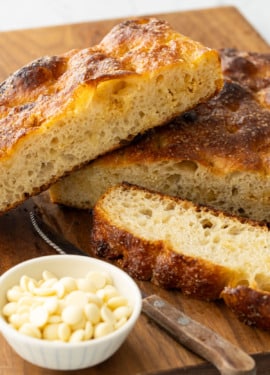
White Chocolate Focaccia Bread
This sweet and salty twist on a classic Italian focaccia features hidden pockets of caramelized white chocolate, a tender crumb, and a deeply golden brown crust topped with flaky sea salt and crunchy turbinado sugar. It's made over 3 days/48 hours for a full flavor and extra bubbly crust, but only 45 minutes of hands-on time required.
Yield: one 9x13-inch loaf (about 8-12 servings)
Ingredients
For Pre-Ferment:
- ¾ cup / 100 g bread flour
- 3 ½ fl. oz. / 100 g lukewarm water, about 80-90ºF
- ⅛ teaspoon / 1.5 g instant yeast, OR 10g active sourdough starter
For Focaccia Dough:
- 1 ¼ cups / 300 g lukewarm water, about 80-90ºF
- 2 tablespoons / 40 g honey
- ¾ teaspoon / 9 g instant yeast
- 2 ⅓ cups / 300 g bread or 00 flour
- ⅔ cup / 100 g semolina rimacinata flour*, or replace with an equal amount BY WEIGHT of bread/00 flour
- 1 tablespoon / 11 g kosher salt
- 1 tablespoon / 14 g olive oil, plus more for oiling the pan and for topping
- ¾ cup / 125 g white chocolate chips or chopped white chocolate
- butter, for greasing the pan
- 1 tablespoon turbinado sugar, for topping
- flaky sea salt, for topping
Instructions
- Day 1: Prepare Pre-Ferment: combine flour, water, and yeast or active sourdough starter in a bowl or container, stirring until incorporated and no dry streaks of flour remain. Lightly cover and set aside at room temperature for 12 hours or overnight, until doubled in size and very bubbly.
- Day 2: Make Dough: Add lukewarm water to container with pre-ferment, along with honey and instant yeast (yeast is needed in this step regardless of whether you used yeast or sourdough in step 1). Stir to combine, then transfer to a large mixing bowl or 4 quart container.
- Add flours to wet ingredients and mix with a spatula or your hands until it comes together into a shaggy, sticky dough. Lightly cover and set aside for 30 minutes.
- After 30 minutes, add salt and use the pincer method to incorporate salt (reach your thumb and forefinger around the dough, then squeeze and pinch the dough between your fingers which will almost split the dough in half. Fold dough over itself, rotate the bowl a quarter turn, then pinch and slice again. Repeat until salt is fully integrated).
- Lightly cover bowl and set aside for 30 minutes. Drizzle 1 tablespoon olive oil on top of the dough, then then stretch and fold the top portion of the dough over itself, tucking it into the bottom. Rotate the bowl a quarter turn (90º) and stretch and fold again. Repeat twice more until you've completed 4 stretch and folds.
- Cover and set aside for 30 more minutes, then do another set of stretch and folds; this will help continue to build structure in the dough without kneading. Cover and set aside for one more 30 minute interval.
- During the last set of stretch and folds, incorporate the white chocolate chips. Sprinkle 1/4 of the chips over the surface of the dough, then stretch and fold the top portion over itself and the chips. Rotate the bowl a quarter turn, sprinkle another quarter of chips over top, and stretch and fold again. Repeat twice more until all the chips are incorporated. Some may fall out and that's ok, but most should be tucked up inside the dough.
- Lightly cover the dough with plastic wrap (leaving plenty of slack for it to double in size), and then place in the refrigerator for at least 10 hours or overnight.
- Day 3: Shape and Bake: Butter and line a 13-by-9-inch light or medium colored metal baking pan with parchment paper; butter parchment, then rub a layer of olive oil over the entire surface, into the corners and up the sides.
- Tip the chilled dough into the prepared baking pan, gently pressing and stretching the dough until it mostly fills the pan to the corners (it's pretty bouncy at this point, but just do the best you can). Drape pan with a clean kitchen towel or lightly oiled plastic wrap and set aside in a warm spot to rise (I like to use my oven with the light on).
- After 1 ½ to 3 hours, the dough should be doubled in size, noticeably bubbly, and very jiggly when you shimmy the pan.
- Drizzle a tablespoon of olive oil over the top of the dough, and oil your fingertips as well. Press your fingers down into the dough over the whole surface, pressing it into the corners and forming the signature focaccia dimples. You want to go pretty deep with the dimples, to the bottom but not breaking through, and preserving the bubbles as best you can (you don't want to deflate the dough, just dimple it).
- Let the dough sit and rest for another 20 to 30 minutes while you preheat your oven to 425 degrees F.
- Just before baking, sprinkle top of focaccia with flaky sea salt and about a tablespoon of turbinado sugar.
- Bake for 15 minutes, rotate the pan, then bake for an additional 10 to 15 minutes or until top is deeply golden brown and the edges are crisp (for an extra brown crust you can give it a second brush of olive oil in this interval). The internal temperature should be at least 200-205°F when done.
- Remove from oven and let cool for at least 45 minutes before slicing and serving warm or at room temperature.
- Leftover bread keeps well, loosely covered at room temperature, though it will loose its crispy crust overnight, particularly if it's humid. I like to rewarm it slightly before serving (about 5 minutes in a 350º oven should do it, or slightly longer/hotter if you want to bring back some of the crisp crust).
Notes
- Semolina rimacinata flour is a fine semolina flour often used in pasta making. It gives the bread a lovely authentic texture and subtle yellow color. You can replace it with an equal amount by weight of bread or 00 flour instead (100g is about 3/4 cup of bread flour; semolina is heavier which is why the volume is not equal).