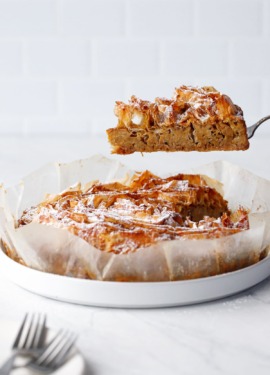
Pumpkin Ruffled Milk Pie
With crispy, ruffled layers of phyllo dough on top and a custardy, bread pudding-like interior infused with pumpkin and spices, this ruffled milk pie is a textural experience unlike anything you've ever had before.
Yield: one 9-inch pie (about 8 servings)
Ingredients
- ¾ cup / 135 g clarified unsalted butter* or ghee
- 16 sheets / 226 g frozen phyllo dough, (16 9x14" or 8 18x14" sheets), fully thawed overnight
- 1 tablespoon / 21 g honey
- ¾ teaspoon ground cinnamon
- ¾ cup / 180 g whole milk
- ½ cup / 120 g heavy cream
- ⅔ cup / 165 g canned pumpkin puree
- 3 large eggs, at room temperature
- ½ cup / 105 g packed light brown sugar
- 1 ½ teaspoons ground cinnamon
- ½ teaspoon ground ginger
- ¼ teaspoon kosher salt
- ⅛ teaspoon freshly ground nutmeg
- ⅛ teaspoon ground cloves
- 2 teaspoons vanilla extract
- powdered sugar, for dusting
Instructions
- Preheat oven to 350 °F. Butter a 9-inch round by 2-inch deep cake pan. Press a sheet of wide parchment paper down into the bottom of the pan, smoothing out the bottom so it sticks and creasing the sides (it won't lie perfectly flat, but that's ok). Trim off any extra tall scraps, leaving parchment about 1 inch above the edge of the pan (2 inches above if your pan is shallower).
- Unroll phyllo dough on a flat work surface. Cover with a sheet of waxed paper and a slightly damp kitchen towel on top; this will help keep the dough from drying out as you work.
- Place one sheet of phyllo dough on a clean surface. Using a wide pastry brush, brush a thin layer of melted clarified butter over the entire surface of the dough.
- Loosely fold into an accordion shape along the long edge. The size of your folds will depend on the size of your phyllo; for example, I used smaller 9-by-14-inch sheets, and made alternating folds about 2 1/4 inches in size (the final shape was like an M, if that helps you visualize the process). Ideally you want the height of your folded dough to be as tall as your cake pan.
- With the raw edges facing up, roll the dough into a rough rosette shape, and place into the center of prepared cake pan. Don't roll too tightly, as you do want to leave space in between the dough layers for the custard to go.
- Take out another sheet of phyllo dough, taking care to keep the rest of the dough covered. Brush with butter, then fold again into an accordion. Place into the cake pan and continue the spiral shape where your last piece ended.
- Continue to butter, fold, and spiral sheets of phyllo dough until the cake pan is completely filled. The dough will collapse inward a bit as it cooks, so if you can pack in another sheet or two around the outer edge it'll bake up more evenly. I used a total of 16 smaller sheets of phyllo for my pie; for larger sheets you may only need 8 or 10.
- Combine 2 tablespoons of remaining butter with 1 tablespoon honey; rewarm for 10 of 15 seconds in the microwave if necessary. Brush top of phyllo spiral generously with butter honey mixture, then dust with cinnamon.
- Bake for 25 minutes or until phyllo is golden brown and crispy. Remove from oven and let cool while you prepare the custard.
- To prepare custard, combine milk, cream, and pumpkin puree in a saucepan. Heat over medium, stirring occasionally, until mixture begins to steam (do not let it fully boil).
- Meanwhile, while milk is heating, whisk eggs with sugar, salt and spices in a medium bowl until frothy. Spoon hot milk mixture, 1/4 cup at a time, into egg mixture, whisking vigorously as you drizzle in the hot milk. This will temper the eggs rather than cook them. Continue adding hot milk, 1/4 cup at at time, until about half of the liquid has been incorporated and mixture is warm to the touch. Pour warm egg mixture back into saucepan with remaining milk and whisk until completely incorporated. Whisk in vanilla extract.
- Pour custard into cake pan, making sure to get custard into all the nooks and crannies between the layers of phyllo dough. The custard should only come about 2/3 of the way up your phyllo dough (you want some to remain uncovered so it stays crispy).
- Place cake pan on a cookie sheet (just in case of overflow), and return to oven. Bake for 25 to 30 minutes or until phyllo is deep golden brown and custard is puffed and set but still slightly jiggly.
- Remove from oven and place pan on a wire rack to cool completely. Use the parchment to lift the entire pie out of the pan and place on a serving plate, peeling down the sides. Dust with powdered sugar before slicing and serving.
Notes
- To clarify butter, melt in a saucepan set over medium-high heat until butter starts to foam and sputter. Stir occasionally and continue to simmer until the sputtering subsides and the white milk solids sink to the bottom of the pan. This is essentially the same process as making browned butter, but we're just not going to cook it long enough to brown. Once the solids have separated, remove from heat and let cool slightly; the solids should settle to the bottom as it cools. Carefully pour or spoon off just the clear part of the butter, leaving the milk solids behind.