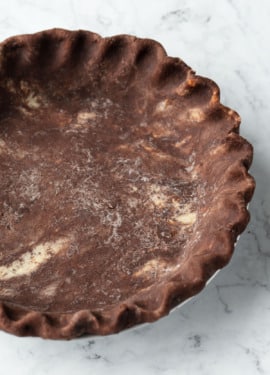
Flaky Chocolate Pie Crust
This flaky chocolate pie crust is everything you love about pie pastry: tender, flaky and buttery, with the addition of cocoa powder for a deeply chocolate flavor that will complement just about any filling.
Yield: 1 9-inch single pie crust
Ingredients
- 1 ½ cups / 187 g all-purpose flour
- 3 tablespoons / 21 g dark or Dutch processed cocoa powder, sifted
- 2 tablespoons / 16 g powdered sugar, sifted
- ½ teaspoon kosher salt, reduce or omit if using salted butter
- 8 tablespoons / 113 g cold unsalted butter, cut into cubes
- 2 tablespoons / 24 g cold vegetable shortening
- 3-5 tablespoons ice water, as needed
Instructions
- In a bowl, sift together flour, cocoa powder, sugar, and salt.
- Sprinkle butter cubes and shortening over flour, then use a pastry blender to cut in the fat until it forms pea-sized pieces. You can also use a food processor or blender for this step if you like!
- Make a well in the center of the dry ingredients, and sprinkle over 3 tablespoons of the ice water. Mix with a fork or (cold!) hands until the dough starts to clump together. Push the clump to the side and sprinkle more water, a teaspoon at a time, over dry bits, mixing until those too start to clump together. Try not to use any more water than necessary to bring the dough together!
- Give the dough a good knead or two until it comes together in a rough, shaggy ball. Turn out onto a piece of plastic wrap spread out on the countertop, then wrap tightly (double wrap if needed). Flatten slightly into a disk. Refrigerate for at least 30-60 minutes or overnight. Pie dough can also be wrapped, bagged, and frozen for up to a month (let thaw overnight in the fridge before rolling).
- Preheat oven to 375 degrees F.
- Roll out dough on a lightly floured countertop or pastry cloth, lightly flouring as needed to prevent sticking (you can also roll between layers of parchment paper). For a standard 9-inch pie pan you're looking for about 14" in diameter to allow for sufficient overhang.
- Fold the rolled dough in half, then carefully transfer to a 9-inch pie pan. Unfold, and gently ease the dough, taking care not to stretch it, into the bottom and corners of the pan.
- Trim off any excess from the edges, leaving a 1" overhang beyond the edge of the pan. Gently fold the overhang back up under itself around the circumference of the pan. Crimp edges using the technique of your choice (I like to use my knuckles, two on the inside and one on the outside, to form the fluted shape.
- Freeze the fluted crust for at least 15 minutes or refrigerate for 30; this will firm up the crust enough that lining it won't mess up the fluted edges.
- Crinkle up a piece of parchment paper and place it in the chilled crust. Fill with weights of some sort (I like to use granulated sugar but you can use pie weights or dried rice or beans too).
- Place crust on a second baking sheet (to catch any leaking butter) and bake with the parchment and weights for 15-20 minutes, until the edges and sides are matte and no longer shiny.
- Gently remove the parchment paper and weights (if you have a second set of hands you can do this all at once). The bottom of the crust will still look a bit wet, that's ok.
- For pies with a baked filling, you can add your filling at this time and then bake according to the recipe instructions.
- For non-baked pie fillings, you'll need to fully bake the crust. First prick the crust all over with a toothpick or fork to prevent puffing, then return to the oven for another 10 to 15 minutes or until the crust appears dry and is no longer shiny on the bottom. Remove from oven and let cool before adding your filling!